
Sunday, August 4, 2013

iPad and iPhone ban vetoed by the Trade Representitive
During the patent battle that Apple and Samsung have been locked in for years, it was ruled that the older models of iPads and iPhones infringed on Samsung's wireless technology patents. After the ruling, those models of iPads and iPhones were banned from sale. However, President Obama's Trade Representative vetoed the decision on the grounds that it damaged competition. The President has 60 days to veto the new decision; if he does not, the old phones can be sold again in 60 days.
Source (BBC)
Source (BBC)
Saturday, August 3, 2013
Why Predicting Technology is so Hard
What are we doing wrong?
Why are predictions of technological advancement so often wrong? Why can't we predict where breakthroughs are going to come from? Often, we'll predict something could never happen, only to be laughably wrong later."A rocket will never be able to leave the Earth's atmosphere." -The New York Times, January 13, 1920
"That the automobile has practically reached the limit of its development is suggested by the fact that during the past year no improvements of a radical nature have been introduced." -Scientific American, January 2, 1909.
"There's no chance that the iPhone is going to get any significant market share." -Steve Ballmer 2007
"With over fifteen types of foreign cars already on sale here, the Japanese auto industry isn't likely to carve out a big share of the market for itself." -Businessweek, August 2, 1968.
Well, even logical sound predictions can be completely turned on their head by a few phenomena described below.
The Public Doesn't Know What it Wants
"A lot of times, people don't know what they want until you show it to them." -Steve JobsSometimes, a new or emergent technology will catch on unexpectedly because people hadn't realized they wanted it. Sound in movies, personal computing, and even the iPhone have been described as impractical and too niche to succeed on a large-scale market. In this case, possibility isn't a question- it's feasibility, practicality, and just the question that every investor asks- "Where's the market for this?"
Innovation comes from an unexpected place
One of the troubles with predicting specific breakthroughs is you never know what will be the focus of innovation and invention. The Industrial Revolution focused on manufacturing, the early 20th century focused on travel, the late 20th century focused on processing, and the 21st century has focused on communication. Of course, processing has improved this century, but nothing so major as the silicon chip versus vacuum tubes. Travel has improved, but nothing like the jump from carriages to automobiles and aircraft.While communication is really the biggest improvement for the last decade, our focus may soon change. 3D printing is very close to bringing focus back to manufacturing, and trouble in the Middle East may soon cause an invention of necessity in the travel industry. Just remember- before you write something off as impossible, think of the quotes above.
Moto X: Everything we know about Google's All-American Phone, Designed by You
As some may already know, Google has officially purchased Motorola. Their first phone under Google will be called the Moto X, and it is sizing up to be an Android flagship. The advertisement campaign has pushed the American manufacturing aspect of the phone. This is likely a direct response to the somewhat recent revelation that Apple's iPhone and iPad are manufactured in China by workers who frequently are underage and/or underpaid.
The Moto X doesn't just focus on it's American aspects- it also touts that is "designed by you."

As you can see, the Moto X isn't a standout in terms of its technology, but the strong Google Now integration and the customizable, Made in the USA ad campaign may help it pull ahead.
The Moto X doesn't just focus on it's American aspects- it also touts that is "designed by you."
A quote from Motorala's website:
"People are skydiving out of space ships. But you can't design your own
phone? Not anymore. Now Moto X lets you choose the front, the back, the
accents, the wallpaper, the memory, and even a short message. It's all
your call."
Below is a table comparing the Moto X to other big-name Android phones. (courtesy of DroidLife)
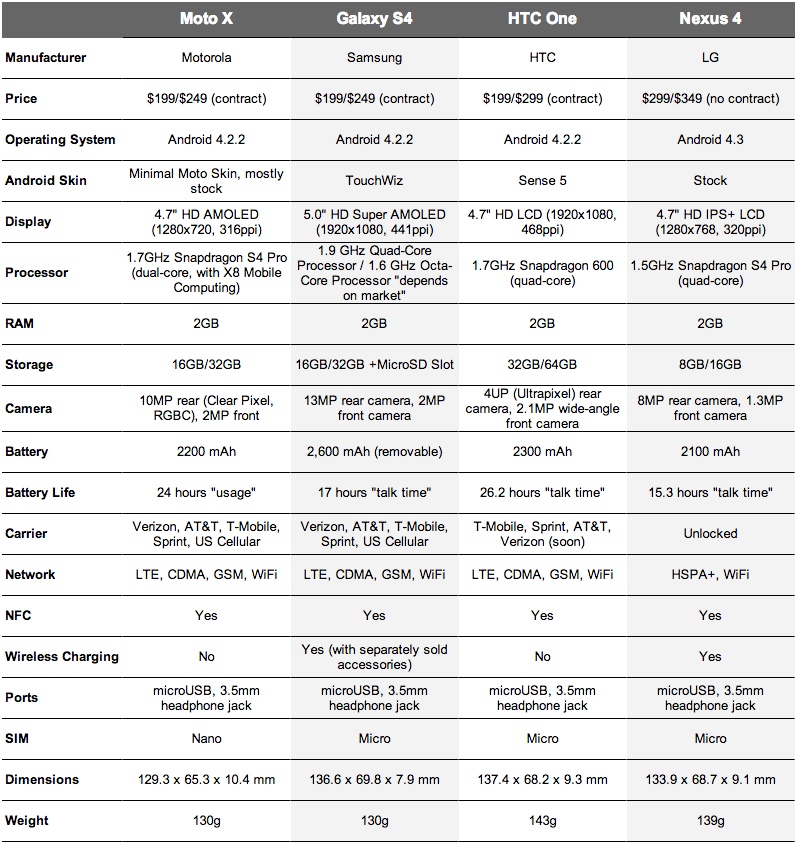
As you can see, the Moto X isn't a standout in terms of its technology, but the strong Google Now integration and the customizable, Made in the USA ad campaign may help it pull ahead.
Friday, August 2, 2013
Who will be the 12th Doctor?
UPDATE: Peter Capaldi will be the new Doctor!
The subject of who will replace Matt Smith as the Doctor is a hotly contested topic amongst fans of BBC's Doctor Who. This Sunday, at 2PM Eastern Standard Time, we'll find out the identity of the actor to play the 12th Doctor in a live event on BBC One.
However, that doesn't mean Smith's run as the Doctor is completely ended; he'll appear in the 50th anniversary special alongside his predecessor David Tennant and then later in the 2013 Christmas special. After that, the actor to be announced tomorrow will step into the role of the Doctor.
The subject of who will replace Matt Smith as the Doctor is a hotly contested topic amongst fans of BBC's Doctor Who. This Sunday, at 2PM Eastern Standard Time, we'll find out the identity of the actor to play the 12th Doctor in a live event on BBC One.
However, that doesn't mean Smith's run as the Doctor is completely ended; he'll appear in the 50th anniversary special alongside his predecessor David Tennant and then later in the 2013 Christmas special. After that, the actor to be announced tomorrow will step into the role of the Doctor.
The Hollywood Effect in Action: Avatar
Fox released the following official statement.
The three pictures will be filmed simultaneously with production beginning next year. The release of the first sequel will be in December 2016, with the second to follow in December 2017, and the third a year later. AVATAR 2, 3, and 4 will be produced by Cameron and Jon Landau through their Lightstorm Entertainment banner. Like the original film, Lightstorm will work with Joe Letteri and his team at WETA Digital to realize the worlds of the sequels.According to the statement, Cameron has decided to film all three films simultaneously to have the movies ready to release the movies every year. This decision is related to the Hollywood Effect I described in my previous post. Hopefully Avatar won't fall into the trap the Aliens franchise did; the first and second movies were received well critically and commercially, but ratings plummeted for the third and fourth installments. I wish Mr. Cameron luck in his endeavor.
Commented Cameron: “Building upon the world we created with AVATAR has been a rare and incredibly rewarding experience. In writing the new films, I’ve come to realize that AVATAR’s world, story and characters have become even richer than I anticipated, and it became apparent that two films would not be enough to capture everything I wanted to put on screen. And to help me continue to expand this universe, I’m pleased to bring aboard Amanda, Rick, Shane and Josh — all writers I’ve long admired - to join me in completing the films screenplays.”
Commented 20th Century Fox chairman and CEO, Jim Gianopulos: “We at the studio have no higher priority, and can feel no greater joy, than enabling Jim to continue and expand his vision of the world of AVATAR. The growing breadth and scale of Jim Cameron’s plans for his magnificent fantasy worlds continue to amaze us all.”
Wednesday, July 31, 2013
The Hollywood Effect
Everything is a Sequel
Has anyone else ever noticed that media seems to always be ruled by giant, monolithic publishers? The effect is most apparent when everything that comes out from that media seems to be the same or is just another sequel. On Business Insider's list of top grossing video games, only four of the ten games listed aren't numbered sequels, only one of them was not a sequel (direct or indirect), and even that one non-sequel (The Sims) went on to have sequels of its own. On IGN's list of top grossing movies, we have 2 prequels, a movie of an existing property, an original movie, an original movie with two sequels already in the works, and 10 sequels. Call of Duty (often abbreviated CoD), a franchise that is one of the most widely recognized in gaming, currently has quite a few games. The original trilogy of Call of Duty games was followed up by another trilogy titled Modern Warfare. In between installments of those six games were Call of Duty: World at War, and two games in the Black Ops series. At present time, one more game has been announced and is forthcoming: Call of Duty: Ghosts. That's ten games for one franchise! Instead of innovating, why do video game developers and movie makers keep making sequels?Giant Publishers
The real reasons there seem to be a plethora of sequels and a derth of new intellectual property is cost. According to Wikipedia, "An average development budget for a multiplatform game is $18-28[million], with high-profile games often exceeding more than $40[million]." Since Hollywood is more secretive about costs of production, I can't find figures as informative, but most blockbusters cost multiple millions of dollars. Considering these costs, it makes that there isn't a lot of risk in those industries. Even though the cost for a book's publication don't generally top a million dollars, the effect is still present in books; a writer must first find a literary agent who then must find a publisher. Television has some of the greatest variety of publishers, since there are hundreds of networks and channels, but those networks and channels must maintain a good relationship with television providers such as Cable and DirectTV. If someone won't or can't work through these established channels, where can they go?Independent Artists
Ever heard of indie developers, independent film makers, or self-published authors? These artists don't work within the bubble of publishers. Independent game developers are generally respected within the industry and are known for creating games that have a deep, moving message or new innovative game play, and can publish through a variety of virtual stores, such as Desura. Independent film makers also have a similar reputation for meaningful, but short, films that they can either sell as physical media through services such as CreateSpace or they can publish on a digital platform such as Amazon Instant Video (again using CreateSpace). Self-published authors aren't viewed the same way, largely due to the low to nonexistent costs of self-publishing; due to low costs, many subpar writers have flooded the self-published market with poor writing and it makes it difficult to locate any good works.As popularity of digital distribution of video games, television, movies, and books grows, independent artists will have an easier and easier time getting their content to a growing audience. Hollywood, the games industry, and book publishers may have to change slighlty, but it seems television may be immune due to the prohibitive costs of producing high-quality work in a sustained manner that independent film makers may not be able to handle. So it seems the Hollywood Effect is still going to continue, at least for now.
Subscribe to:
Posts (Atom)